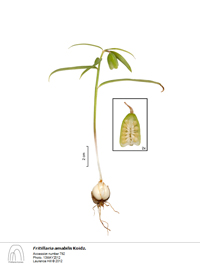
PHYSIOLOGY
Molecular phylogenetic analysis of Lilium and Fritillaria show they are sister genera with early diverging Fritillaria retaining many of the morphological and life cycle characteristics of Lilium. Temporal, morphological and habitat changes in other members of the genus show a shift from mesomorphic to zeromorphic adaptation. Most Fritillaria can be characterised as flowering in the spring in seasonally moist open habitats with dry summers. Many Fritillaria occur in areas where there are higher levels of precipitation during their summer dormant period than at flowering time indicating cool temperature and not soil moisture govern their flowering period.
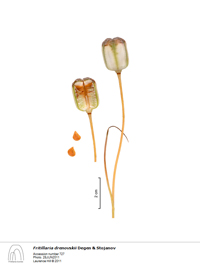
Most Fritillaria species have two periods of growth and two periods of dormancy that closely correspond to seasonal changes in soil temperature. In the autumn new adventitious roots emerge from the base of the stem passing through the scales of the current seasons bulb. The inflorescence bud also elongates during this period. The first period of dormancy occurs with the onset of winter and corresponding reduction in soil temperature. In spring as the soil temperature and moisture levels increase Fritillaria enter their most active growth phase with the roots and shoot fully elongating. Stalk elongation and anthesis requires cool temperatures (5-9 °C during daylight hours). At high altitude and/or latitude flowering may not occur until June or July. In these areas Fritillaria are often found by melting snow or in seasonally moist areas and are one of the first plants to come into flower. Individuals flower for about 10-14 days and after pollination the developing capsule takes 6-8 weeks to mature. In early summer as the soil temperature increases the second period of dormancy occurs.